
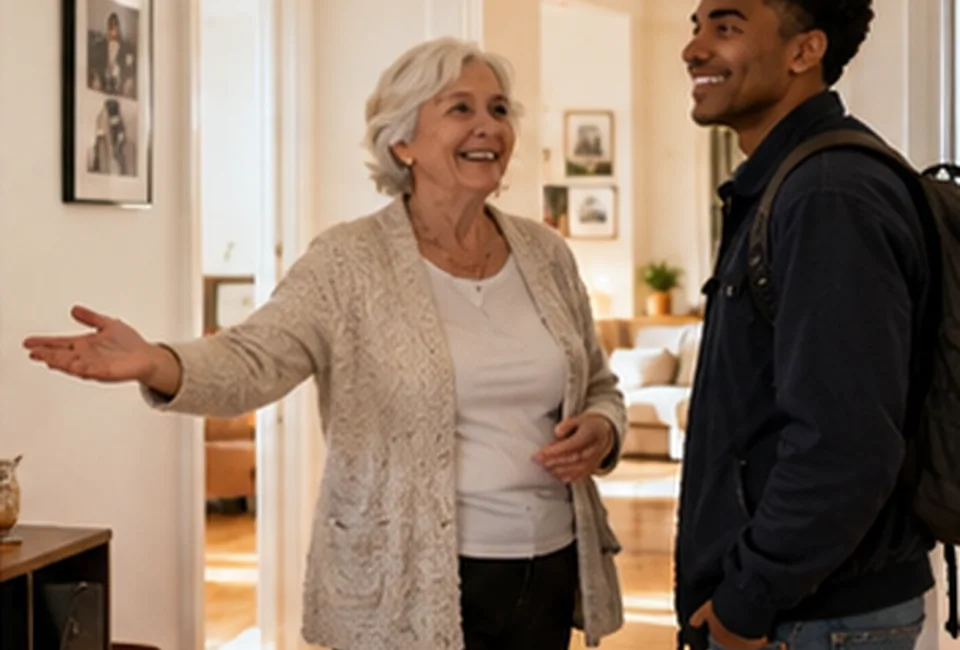
Who actually becomes a host?
A 2020 study for France’s national pension fund, the Cnav, profiled householders supported by French matching charities. Between 80 and 85 percent were women, and their average age reached 81 in arrangements built around evening presence and 74 in looser, more independent ones.
The same research uncovered a striking gap between sympathy and action. Some 84 percent of respondents liked the idea, yet only 23 percent of people over 60 were personally tempted, leaving 61.5 percent of young applicants without a match because too few rooms were offered.
How other countries frame the deal
Ireland’s THE HomeShare asks the younger sharer for at least ten hours of support each week plus overnight presence. In England, Derby City Council works with the organisation Two Generations, which pairs older people living alone with a younger person seeking affordable lodging.
The French rules in one line
Since 2018 France has offered a dedicated contract allowing anyone aged 60 or over to let part of their home to someone under 30, outside ordinary tenancy law. Beyond that, success depends on practical preparation rather than legal detail.
What the young sharer is not
A homesharer may carry shopping, change a light bulb or share supper, but is never an employee, a care worker or a nurse. When a host’s health declines, the organisation should check that professional services are in place instead of leaning on the student.
Getting the spare room ready
Applicants often visit several homes before choosing. A bright, tidy room with a proper place to study matters far more than décor. A French Senate bill tabled in 2023 suggested a minimum of 9 square metres, a sensible yardstick even where no rule applies.
What should the room contain?
Think like a student who will spend evenings revising and mornings rushing to lectures. The checklist below covers the basics most matching organisations expect to see on their home visit, with a short note on why each item makes daily life easier.
| Item | Why it matters | Practical tip |
|---|---|---|
| Comfortable bed | The first thing visitors check | Fresh mattress protector and spare bedding |
| Desk and chair | Coursework, online classes, remote work | Position near natural light |
| Empty wardrobe and shelves | Young people arrive with a lot of belongings | Clear them before the first viewing |
| Reliable wifi | Essential for any course | Write the password on a card |
| Lockable door | Privacy on both sides | Keep a spare key somewhere safe |
Sharing the kitchen and bathroom
Friction rarely comes from big principles. It comes from a crowded fridge shelf, a long morning shower or laundry drying in the hall. Giving the sharer a cupboard of their own and agreeing washing-machine slots heads off most of these irritations early.
Telling the landlord and the insurer
Hosts who rent their home should inform their landlord before anyone moves in; under French practice the Cnav study notes that notification, not permission, is required. A quick call to the home insurer confirms that an extra occupant is covered.
Choosing a homeshare organisation
Good organisations interview both parties, visit the home, draft a household agreement and stay in touch afterwards. Meeting two of them before committing is worthwhile, because the depth of follow-up varies far more than the fees, which rarely tell the whole story.
What does matching cost?
Fees recorded in France in 2020 ranged from nothing at subsidised charities such as Toit+Moi to between 220 and 390 euros at Ensemble 2 Générations. Others charged a monthly membership of about 33 euros, plus a modest file fee when the match was made.
On the income side, young people in one French network paid an average of 194 euros a month in 2020, Paris included, while the host’s extra running costs were put at around 57 euros monthly. Amounts abroad, and today, will differ considerably.
How a match comes together
Each organisation works slightly differently, yet the path from first phone call to moving day follows similar steps everywhere. Throughout the process, the host keeps the final say on who comes to live in the house, and nobody is placed without a meeting.
- Initial phone conversation about your expectations and routine.
- Home visit by the organisation to see the room.
- Agreement on needs such as evening company, pets or quiet hours.
- Presentation of one or two carefully screened profiles.
- Meeting with the young person, often with a coordinator present.
- Signing the contract and a written household agreement.
- Review after the first month, then at regular intervals.
Light-touch or support-based arrangement?
Two broad models exist in France and beyond. One values independence and asks little beyond a contribution; the other trades a reduced payment for agreed evenings at home. The right choice depends on how much company the householder genuinely wants.
| Feature | Light-touch model | Support-based model |
|---|---|---|
| Presence commitment | None | Agreed evenings each week |
| Money paid by the sharer | Low but regular | Very low, sometimes only bills |
| Average host age in France, 2020 | 74 | 81 |
| Typical host | Active and independent | Living alone, somewhat frailer |
Mistakes that undermine a homeshare
Most arrangements that end early stumble over avoidable misunderstandings rather than serious conflict. Coordinators in several countries describe the same handful of traps, nearly all linked to expectations that nobody wrote down before the sharer unpacked.
- Expecting help with washing, dressing or medication.
- Leaving rules about guests and late returns unspoken.
- Underestimating how much space a young adult occupies.
- Choosing an organisation on price alone, ignoring follow-up.
- Keeping adult children in the dark until after the move.
- Letting a small annoyance fester for weeks instead of calling the coordinator.
Keeping expectations realistic
Students sit exams, take placements and have friends. Some weekends they will be away, sometimes several in a row. Accepting this from the start, and naming the specific evenings when presence really matters, works far better than hoping for constant availability.
When the relationship falters
This is where the organisation earns its fee. A mediated conversation often resets things. If tension persists, the contract lets either side leave after notice, and the coordinator can usually propose a better-suited sharer for the following term.
Questions hosts ask first
Coordinators hear the same handful of questions in almost every first conversation with an older householder. They concern tenure, freedom of choice, the sharer’s social life and whether the money received will be taxed by the authorities.
Do I need to own my home?
No. In France, tenants in private or social housing may also host. In social housing, the contribution is calculated in proportion to the floor area used, according to the Cohabilis network. The landlord simply needs to be told beforehand.
Can I turn down a proposed sharer?
Yes. The organisation suggests profiles, but the householder decides after meeting them. A refusal needs no lengthy justification; it actually helps the coordinator sharpen the next selection, which is often arranged within a few weeks.
May the sharer invite friends round?
That is settled together and written into the household agreement. Some hosts welcome daytime visitors but refuse overnight guests; others simply ask for a text in advance. What matters is that the rule is clear before the first night.
Is the contribution taxable in France?
It can be tax-free when the room becomes the young person’s main home and the rent stays reasonable. For 2026, the French tax authorities accept up to 215 euros per square metre per year around Paris and 159 euros elsewhere.
Useful organisations and resources
- Derby Homeshare with Two Generations — English council scheme run with Two Generations, matching older people who have a spare room with younger sharers.
- THE HomeShare (Ireland) — Not-for-profit Irish programme matching householders with sharers who give ten hours of weekly support and overnight presence.
- Cohabilis (France) — French national network of homesharing charities; this 2026 factsheet explains contributions, small services and the role of member organisations.
- Cnav study on intergenerational homesharing — French pension fund report on host profiles, charity fees, motivations and obstacles, based on fieldwork with matching organisations.
Official and legal references
- French Construction and Housing Code – intergenerational homesharing — Official French text on Légifrance setting out the contract between a host aged 60 or over and a sharer under 30.
- French Senate bill no. 81 (2023-2024) — Senate proposal including a minimum room size and a national fund for homesharing charities; useful context on reform debates.